
Reviewed · HISTORICAL TOURS
Medical and Surgical History of Edinburgh – Private Walking Tour
Edinburgh’s medical story is written into its lanes, courtyards, hospitals, and university buildings. This private walk follows that story from the Royal Mile to the former Royal Infirmary, linking famous doctors and surgeons with the hard, often grim work of learning medicine in earlier centuries.
I like the clear sense of place here: Robertson’s Close, the first teaching hospital, and the former Royal Infirmary are not just names in a lecture. You walk between the actual sites. I also like the small private format, which gives guide Moray, also referred to as Dr. Grigor, room to pace the talk around your interests.
The main caution is the distance. The route covers about 2.5 miles over three to four hours, with hills and city walking. It is not a good choice for anyone with chronic or painful musculoskeletal problems, and the café stop adds time rather than replacing the need for comfortable shoes.
Key points to know before booking
- A 2.5-mile route connects real medical sites, from Hunter Square and the Royal Mile to the former Royal Infirmary.
- Guide Moray, also known as Dr. Grigor, brings a physician’s perspective to Edinburgh’s medical and social history.
- The tour is private, so only your group takes part and the pace can suit your interests.
- Women’s struggle to enter medical education receives special attention at Surgeons’ Hall Museums.
- A café break is built into the walk, but coffee, tea, and food cost extra.
- The experience takes three to four hours, sometimes longer, and requires a moderate level of fitness.
Edinburgh medicine begins on the Royal Mile
Meet at Hunter Square, a useful starting point near the lower end of the Royal Mile. From here, the walk heads along Edinburgh’s oldest main street, where the story of organized medicine and surgery in the city begins.
The first section lasts about 45 minutes. You’ll hear about the origins of Edinburgh medicine and find the alleyway connected with the city’s College of Physicians. That detail gives the opening a strong local flavor. Instead of starting with a broad lecture on Scottish medicine, the guide uses a narrow lane and familiar street to show how professional medicine took root.
This is one of the tour’s best ideas. The Royal Mile is often treated as a parade of churches, shops, and tourist stops. Here, you get another reading of the same street. Its closes and buildings become clues to Edinburgh’s early medical institutions.
The stop has no admission fee, and you remain outdoors. That keeps the opening simple, though you should expect city surfaces, uneven paving, and the usual pedestrian traffic of the Old Town. Since the tour begins in a central part of Edinburgh, it is easy to combine with other sightseeing, but I would avoid booking anything demanding immediately before it.
More history walks in Edinburgh:
- Old Town Walking Tour History and Tales in Edinburgh
★ 5.0 · 2,168 reviews - Old Town Historical and Underground Tour
★ 5.0 · 1,574 reviews - Multi-Sensory Small-Group Historic Vaults Tour in Edinburgh
★ 4.5 · 1,384 reviews
Robertson’s Close and the first teaching hospital
The route then drops toward the Cowgate, one of Edinburgh’s lower streets. Just off it, you’ll locate Robertson’s Close, the site of The Little House, described as the city’s first teaching hospital.
The name sounds almost quaint, but the subject is not. This part of the walk shows how medical teaching moved from small beginnings toward formal institutions. You’ll then explore the complex connected with the first Royal Infirmary of Edinburgh, the successor to that early teaching hospital.
Allow about an hour here. It is the longest single stop, and that makes sense. The Cowgate section deals with the physical growth of medical education and hospital care, not just individual doctors. You begin to see how Edinburgh developed into a medical center through buildings, teaching, practice, and institutional ambition.
I especially like this part for visitors who want social history rather than a list of famous names. A hospital tells you about patients, students, teachers, class, work, and public health all at once. The guide’s own background as a physician adds a useful personal angle, particularly when the conversation turns toward healthcare and the way medical practice changed over time.
The route here may feel less polished than the grand university buildings later in the walk. That is part of its value. You are following the working story of medicine through the older, tighter parts of Edinburgh rather than moving from one postcard view to another.
Surgeons’ Hall and the fight for medical education
After the Cowgate, the tour reaches Surgeons’ Hall Museums, the historic home of Edinburgh’s surgical profession. The scheduled time here is about 45 minutes, and this is also where the refreshment break takes place.
Food and drink are not included, so plan to pay separately for coffee, tea, or anything you order. The break matters for more than comfort. By this point, you have been walking and listening for close to two hours, and a pause gives you time to sort the names, dates, and ideas before the final sections.
The discussion here includes the long struggle to admit women to medical school. This is one of the most important parts of the tour because it widens the story beyond famous male surgeons. Medical progress was not open to everyone who wanted to study, and the fight for women’s admission exposes the rules and barriers built into professional education.
You should note that the walking tour does not mean a museum visit is included. The route takes you to Surgeons’ Hall Museums and uses the site for commentary and the café break, but the tour information does not include museum admission or a museum visit. If you want to explore the collections separately, ask about timing before booking other plans.
For me, this stop also helps explain why the tour works well for people interested in the social history of medicine. It connects buildings and institutions with questions of access, status, gender, and education. You are not only hearing what doctors achieved. You are also hearing who was kept outside the profession and how that changed.
The University of Edinburgh and the student life behind the names
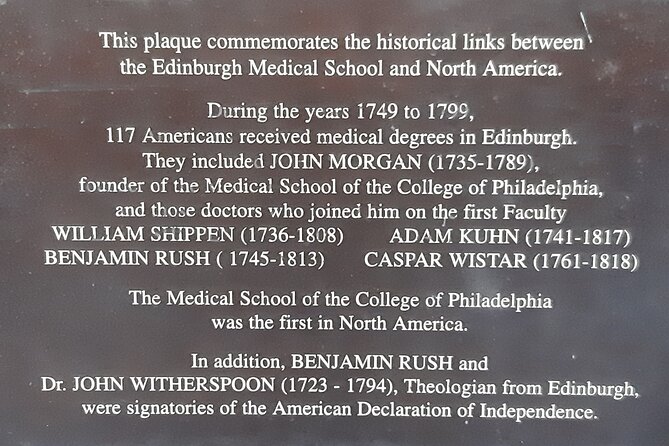
The next stop is the former home of the University of Edinburgh’s Medical School. The formal visit is shorter, about 20 minutes, but it carries the story forward.
Here, the guide explains why Edinburgh became increasingly important as a medical center. You’ll also hear about the daily grind and occasional rewards of medical student life. That promise of student detail is useful. Great doctors can seem distant when reduced to portraits and plaques, but student routines make the past easier to picture.
Expect this section to be more about explanation than a long stop. You are moving through the city, and the time allocation reflects that. The guide can connect the institution to the earlier hospitals and to the training system that produced Edinburgh’s medical reputation.
The private format helps here. If your group has a medical background, you can spend more time comparing past and present training. If you know little about medicine, you can ask for the basic version without feeling that you are slowing a large group.
The experience is offered in English only. That is worth noting if you are choosing among guided walks in Edinburgh. The material is specialized, but the reviews describe the delivery as entertaining and easy to follow, with plenty of room for conversation.
More walking tours in Edinburgh:
- Underground Vaults Walking Tour in Edinburgh Old Town
★ 4.5 · 8,506 reviews - Edinburgh Castle: Guided Walking Tour with Entry Ticket
★ 5.0 · 5,540 reviews - Edinburgh Castle Guided Walking Tour in English
★ 5.0 · 5,214 reviews - Edinburgh Darkside Walking Tour: Mysteries, Murder and Legends
★ 5.0 · 3,862 reviews
Bristo Place, Charles Darwin, and the 1880s medical school
At Bristo Place, the walk passes the former lodging site of Charles Darwin, who studied medicine in Edinburgh. The stop lasts about 25 minutes and then leads toward the imposing 1880s Medical School and graduation hall.
Darwin’s connection gives this section an immediately recognizable name, but the larger point is the setting in which medical students lived and trained. His old lodging site becomes part of a wider story about Edinburgh’s pull for students and the city’s role in medical education.
The 1880s buildings also show how much the profession had changed from the era of The Little House. The scale is different, and so is the confidence of the institution. A walk between these places lets you read medical development through architecture: early, limited teaching spaces give way to purpose-built academic buildings and a formal graduation hall.
This may be a highlight for visitors who enjoy connecting well-known people with ordinary city addresses. It is not presented as a separate Darwin tour, so do not book this expecting a long account of his later scientific work. The focus remains Edinburgh, medicine, and medical education.
It is also a good point to think about the tour’s balance. You get major names and grand buildings, but you also get student hardship, institutional politics, and professional barriers. That mixture keeps the route from becoming a simple parade of achievements.
Lauriston Place and the former Royal Infirmary
The final section reaches Lauriston Place and the grand front courtyard of the former Royal Infirmary of Edinburgh. Today, the finish is at the Edinburgh Futures Institute, part of the University of Edinburgh, at 1 Lauriston Place.
Allow about 15 minutes for the closing stop. The guide tells stories of the doctors and surgeons associated with the institution, bringing the walk back to the people who worked within the hospitals and schools you have traced across the city.
This is a fitting end because it gathers the strands together. You have followed the beginnings of professional medicine, the first teaching hospital, the Royal Infirmary, the medical school, student life, women’s access to training, and the changing scale of medical education. The courtyard gives the finale a sense of arrival without requiring another admission ticket.
The end point is not the same as the start. That is practical to remember when planning the rest of your day. You finish farther south, near Lauriston Place, rather than returning to Hunter Square. The location is still within Edinburgh’s central sightseeing area, but leave yourself time to walk onward or use public transport.
What the private format adds at $130.44 per person
The listed price is $130.44 per person, which places this well above a standard public walking tour. The value comes from the subject and the private setup, not from included admissions or refreshments. All guiding and commentary are included, while coffee, tea, food, and any separate museum admission are extra.
I would judge the price by asking how much you want this particular subject. If you have a serious interest in medicine, surgery, medical education, public health, or Edinburgh’s social past, three to four hours of focused guiding can be worthwhile. You are not paying simply to see the Royal Mile. You are paying for the connections between places that are easy to pass without context.
The private format matters most for a mixed group. You can ask about Scottish doctors, compare historic and modern healthcare, or spend more time on women’s medical education without trying to catch the guide’s attention in a large crowd. The guide’s medical background is another part of the value, since the discussion can move beyond dates and buildings into the meaning of medical work.
Group discounts may improve the cost for larger parties, though the exact discount is not stated. I would check the final price for your group before booking. Since only your party participates, this can work better for families or friends with a shared interest than for someone hoping to meet a broad mix of people.
The high rating and full recommendation rate suggest the experience has delivered strongly for its intended audience, but I would not use that as a reason to book blindly. The subject is narrow. If you prefer art, royal history, food, or general sightseeing, a broader Edinburgh tour will probably give you more for your time and money.
Pace, fitness, and practical planning
The tour lasts about three to four hours and covers roughly 2.5 miles. One review describes a tour lasting more than four hours, so you should leave a little extra room in your schedule. The café stop can make the day more pleasant, but it does not shorten the walking distance.
A moderate level of physical fitness is recommended. Edinburgh’s Old Town includes slopes, steps, uneven paving, and tight lanes, even when a route does not list every challenge in detail. Wear shoes you can use comfortably for several hours and avoid carrying a heavy bag.
The operator specifically advises against the tour for people with chronic or painful musculoskeletal conditions. That warning deserves attention. This is not a brief stop-by-stop outing with a vehicle between sites. You walk from Hunter Square through the Cowgate area and onward to Lauriston Place.
The tour requires good weather. If poor weather causes cancellation, you are offered another date or a full refund. Normal cancellation is free up to 24 hours before the start time, while cancellations or changes inside that period are not refunded or accepted.
Service animals are allowed, and the route is near public transportation. Confirmation is sent within 48 hours, subject to availability. The listed operating period runs from August 31, 2021, to February 16, 2027, with hours shown as Monday through Sunday, 8:00 a.m. to 2:00 p.m. Confirm the exact start time when you book, since the meeting point and walking time make a same-day schedule important.
Who will get the most from this walk
I would recommend this experience first to:
- People working in healthcare, medicine, nursing, or medical education
- Visitors interested in the social history of medicine
- University students and academics
- Anyone who enjoys city walks built around buildings and local stories
- Families or friends who prefer a private guide and can manage the distance
- Returning visitors who have already seen Edinburgh’s standard highlights
It is also suitable for someone who wants a more focused view of Scotland’s contribution to medicine. The guide’s physician background can make professional details easier to understand, while the city setting keeps the subject grounded in real places.
I would be more cautious if you have only one free afternoon in Edinburgh and want a broad first look at the city. The route spends much of its time on medical institutions, hospitals, doctors, surgeons, and students. That focus is the reason to book it, not something to tolerate.
Should you book the Medical and Surgical History of Edinburgh walk?
Book it if you want Edinburgh explained through medicine rather than simply photographed. The strongest parts are the progression from the Royal Mile to the first teaching hospital, the discussion of women entering medical education, the physician’s perspective from Moray, and the private pace.
Skip it if a 2.5-mile walk is uncomfortable, if you want a museum-heavy experience, or if medical history is not a real interest. Also remember that the café stop and any museum visit are not included in the price.
For the right person, this is a thoughtful way to see familiar Edinburgh from a fresh angle. You leave with more than a collection of famous names. You understand how streets, hospitals, schools, and professional battles helped shape the city’s medical identity.
FAQ
Where does the tour start?
The tour starts at Hunter Square, Edinburgh EH1, near the Royal Mile.
Where does the tour finish?
It finishes in the front courtyard of the former Royal Infirmary of Edinburgh, now the Edinburgh Futures Institute at 1 Lauriston Place, Edinburgh EH3 9EF.
How long is the walking tour?
The tour lasts approximately three to four hours and covers about 2.5 miles.
Is the tour private?
Yes. Only your group participates in this private activity.
Are food and drinks included?
No. The tour includes a refreshment café stop, but coffee, tea, and food are not included in the price.
Can I cancel for a refund?
You can cancel at least 24 hours before the start time for a full refund. If poor weather causes the operator to cancel, you are offered another date or a full refund.
Just added around Edinburgh
- Whisky Tasting at Edinburgh’s Award Winning Whiski Rooms★ 5.0 · 5 reviews
- Edinburgh: West Highlands Privately Guided Day Tour in Luxury MPV★ 5.0 · 10 reviews
- From Edinburgh: 5 Day Best of Northern England Tour★ 5.0 · 5 reviews
- Edinburgh Experience By Car★ 5.0 · 5 reviews
- Highlights from Edinburgh’s Old Town: A Self-Guided Audio Tour★ 5.0 · 4 reviews
- West Coast Lochs & Castles Tour – from Edinburgh★ 5.0 · 21 reviews
- Private Edinburgh City Tour★ 4.5 · 10 reviews
- Shore Excursion: Private Braveheart & Whisky country from Edinburgh★ 5.0 · 3 reviews
Historical Tours, compared.

Old Town Walking Tour History and Tales in Edinburgh
Read our review →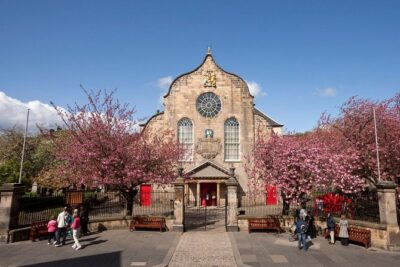
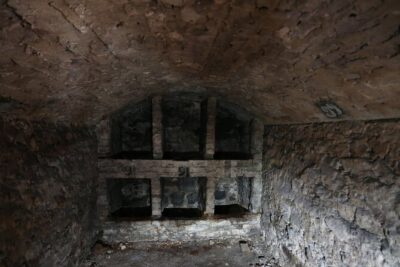
Multi-Sensory Small-Group Historic Vaults Tour in Edinburgh
Read our review →
Edinburgh Old Town: Historical Guided Walking Tour
Read our review →
Browse the lists this tour appears in